
Home > Who we are > Saint Romuald
Saint Romuald
Sit in your cell as in paradise. Put the whole world behind you and forget it.
 The year of birth of the founder of the Camaldolese Order is not entirely certain. Many publications indicate the year 951 or 952, but 907 is also very likely. He came from the illustrious Italian family of the Dukes of Ravenna.
In his youth, he led a worldly life, full of games and pleasures. At the age of twenty, he witnessed the murder of a relative in a duel by his father Sergio. Romuald decided to atone for his father’s deed and did penance for 40 days in a Benedictine monastery. His stay in the monastery, which was a penance, purified and strengthened his conscience, reconciled him with his neighbor, and converted him to God. During this period, St. Apollinaris, the patron saint of the monastery, appeared to him twice, which consequently prompted Romuald to dedicate his life to God. He was admitted to the Benedictine congregation where he was a model of hermitage, virtue, and monastic austerity. The laxity, freedom, and lack of discipline that prevailed at that time led him, with the consent of his superiors, to go with his friend Marine to the monastery of Cux, on the border between present-day France and Spain. There they lived in separate houses, cultivating the land, observing strict fasts and silence, and coming together only for communal meals and prayers. In the abbey of Cux, Romuald learned about the writings of the Desert Fathers (Christian monks who lived alone from the 4th to the end of the 5th century in the deserts of Egypt, Syria, and Palestine).
Around the year 988, Romuald returned to Ravenna and founded a hermitage near the Benedictine abbey in a place called Pereum.
Romuald had an extraordinary personality and led an exceptionally ascetic life, radiating peace, wisdom, power, and the love of God. Biographers emphasize his cheerful and even playful disposition, which blended perfectly with his patriarchal dignity. He welcomed everyone and rejected no one. Therefore, after a short time, the hermitage could no longer accommodate St. Romuald’s disciples. He developed a method of proceeding: for those who were less resistant to the difficulties of hermit life, he built a monastery near the hermitage. When it filled up with monks, he entrusted its management to a chosen disciple, while he moved with a small group or alone to another hidden place in the forest wilderness. He founded a dozen hermitages. He is best known in Pereum near Ravenna and Campo di Maldoli in Tuscany, whose name Camaldoli later gave the order its name. The monasteries and abbeys that were founded were Benedictine congregations.
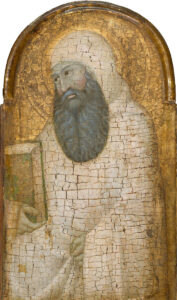
Of the various hermitages founded by Saint Romuald, only the hermitage of Camaldoli, located in the Tuscan Apennines, survived and became the cradle and center of the Camaldolese Order. The fourth prior of this hermitage, Blessed Rodolfo, drew up the guidelines and instructions given by Saint Romuald in the form of a constitution, thus creating the first document of Camaldolese legislation
It was not until 1072 that Pope Alexander II allowed the Camaldolese to separate from the Benedictine congregation and found a new order.
Among St. Romuald’s disciples are saints of the Catholic Church who are well known to us: St. Bruno of Querfurt, St. Pier Damiani, Benedict and John, two of the Five Martyr Brothers of Międzyrzecze, St. Adalbert, Gregory XVI (Pope from 1831 to 1846).
We have information about the life and work of St. Romuald from St. Peter Damian, who says: “The Holy Spirit, dwelling in his heart, aroused this terror in the wicked.” He also ensured that “wherever a holy man went, he always reaped harvests, gained souls, tore people away from the world, and inflamed people’s minds so much with heavenly things that the whole world seemed to be engulfed in flames.”
St. Bruno of Querfurt, in his work “The Life of the Five Brothers,” presents the charism of the Camaldolese monks. It is described as the “triplex bonum” (triple good): “for novices who came from the world, a monastery was desired; for those who were mature and thirsty for the living God, perfect solitude was desired; and for those who desired to separate themselves from this life and be with Christ, the opportunity to preach the Gospel to the pagans was desired.” Thanks to St. Romuald, the Camaldolese were able to combine community life with the hermitic life in hermitages. This was expressed in the emblem chosen for the Order: two doves drinking from the same cup.
St. Romuald died in the monastery of Val de Castro near Ancona on June 19, 1027.
Saint Romuald’s Brief Rule
Sit in your cell as in paradise. Put the whole world behind you and forget it. Watch your thoughts like a good fisherman watching for fish. The path you must follow is in the Psalms—never leave it.
If you have just come to the monastery, and in spite of your good will you cannot accomplish what you want, take every opportunity you can to sing the Psalms in your heart and to understand them with your mind.
And if your mind wanders as you read, do not give up; hurry back and apply your mind to the words once more.
Realize above all that you are in God’s presence, and stand there with the attitude of one who stands before the emperor.
Empty yourself completely and sit waiting, content with the grace of God, like the chick who tastes nothing and eats nothing but what his mother brings him.
___________________
Saint Romuald’s Brief Rule is taken from Saint Bruno of Qerfurt’s Lives of the Five Brothers. It was written around AD 1006—about twenty years before Saint Romuald’s death—and is based on reports from Saint John, one of the “five brothers,” who, like Saint Bruno, knew Saint Romuald well. We can therefore be certain we have here an authentic version of Saint Romuald’s teaching and spirit.